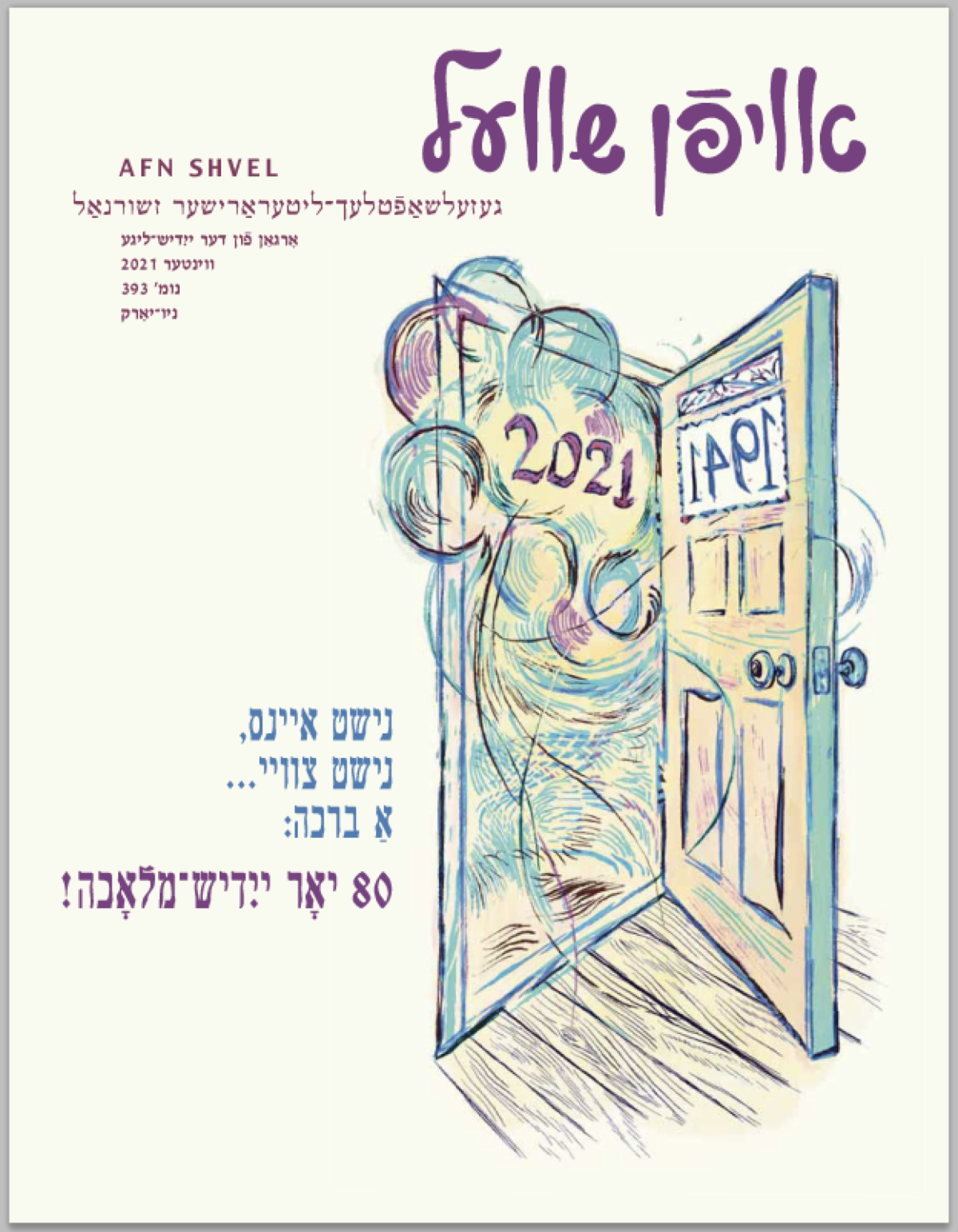
Afn Shvel was originally created as the organ of the Freeland League for Jewish Territorialist Colonization, founded in 1935 to identify a safe haven for Yiddish-speaking Jews. As Dr. Sheva Zucker explained in her Afn Shvel article in Summer 2011 (#352-353), the Freeland League considered territories as far-flung as Western Australia, Suriname and Alaska, for Jewish resettlement.
In 1979, the noted Yiddish linguist Dr. Mordkhe Schaechter led the restructuring of the group into the League for Yiddish, a non-political, Yiddish cultural advocacy organization. The goals of the League for Yiddish stand firm to this day: to encourage people to speak Yiddish in their everyday lives; enhance the prestige of Yiddish as a living language, both within and outside the Yiddish-speaking community; and promote the modernization of Yiddish. The League for Yiddish is dedicated to promoting Yiddish as a dynamic, living language, both within and outside the Yiddish-speaking community, through publication, education and research.
Today’s technology has been a boon for Yiddish and for Afn Shvel’s new editor, Dr. Miriam Trinh of Hebrew University. Trinh is cultivating a new generation of Yiddish writers for Afn Shvel from Israel, Europe and North and South America. Live interviews with Afn Shvel authors via Zoom are attracting global audiences eager to build their fluency in contemporary Yiddish and learn about new Yiddish writers/writing.
“Afn Shvel and the League for Yiddish bring together people who are seriously committed to Yiddish as a dynamic, living language, no matter their political or religious beliefs,” says Trinh. “The magazine appeals not only to native-born speakers, but to readers seeking to improve their fluency.” Articles with a Yiddish-English dictionary embedded in the text are available at https://leagueforyiddish.org/artiklenplus.html, to easily allow the reader to look up words.
###